




Securing a high distinction on a university essay is not merely about being "smart" or
spending endless hours in the library. It is about understanding the specific architecture that
makes a paper stand out to a professor. Academic writing is a craft, and like any craft, it
requires a reliable set of blueprints. When you look at an essay that earns top marks, you
see more than just good grammar; you see a logical flow, rigorous evidence, and a clear
voice.
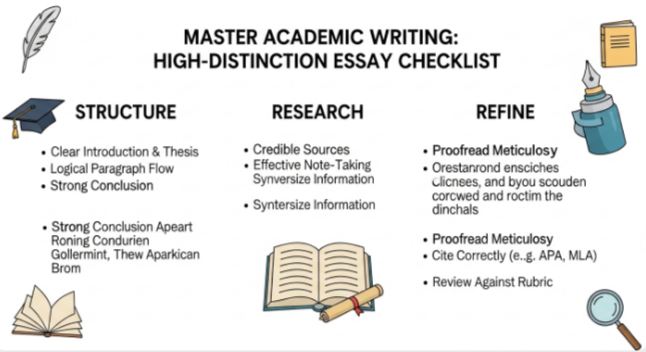
This checklist breaks down the vital components of a superior essay, ensuring your next
submission meets the highest academic standards.
Decoding the Prompt and Planning
The journey toward a top grade begins long before you type the first word of your
introduction. Many students stumble because they fail to truly grasp what the assignment
asks of them.
- Identify Action Verbs: Does the prompt ask you to "analyze," "evaluate," "compare,"
or "describe"? Each of these requires a different cognitive approach. - Establish a Unique Angle: High-distinction papers often move beyond the obvious.
Instead of just summarizing a topic, find a specific tension or a lesser-known
perspective to explore. - Create a Skeleton: Never write "off the cuff." A detailed outline acts as a roadmap,
keeping your arguments focused and preventing the "rambling" effect that often leads
to lower grades.
The Foundation: A Powerful Thesis Statement
Your thesis is the heart of your essay. It is the central claim that every single paragraph must
support. A weak thesis leads to a disjointed paper. A strong thesis is debatable, specific, and
concise.
If you are struggling to categorize your ideas or find a central theme, exploring a diverse
topic for classification essay can help you understand how to group complex concepts into a
cohesive argument. This clarity is essential because if you cannot explain your main point in
two sentences, you probably don't understand it well enough yet.
Structural Integrity: The Introduction
The introduction serves as a handshake with your reader. It needs to provide context without
being overly broad. Avoid starting with clichés such as "Since the dawn of time." Instead,
dive straight into the relevance of the topic.
- The Hook: Start with a provocative question, a surprising statistic, or a significant
quote. - Contextual Background: Briefly explain the current state of the debate or the
historical background of your subject. - The Roadmap: Tell the reader exactly what you will cover and in what order. This
transparency is a hallmark of sophisticated writing.
Evidence-Based Body Paragraphs
Each body paragraph should function as a mini-essay. It must have a clear topic sentence,
supporting evidence, and a concluding thought that links back to the thesis.
- Primary and Secondary Sources: Use peer-reviewed journals and reputable
books. Avoid using non-academic websites or encyclopedias as your main evidence. - The "PEEL" Method: Point, Evidence, Explanation, and Link. This ensures that you
aren't just dropping quotes into the text but actually explaining why they matter. - Critical Analysis: Don't just tell the reader what happened. Explain why it happened
and what the implications are. This is where most students move from a "Credit" to a
"High Distinction."
Mastering Complexity and Classification
As assignments become more advanced, the ability to organize information into logical
categories becomes a vital skill. Whether you are analyzing different legal theories or various
psychological frameworks, your ability to classify and compare data shows a high level of
intellectual maturity.
For those tackling particularly intricate subjects where the organization of ideas is the
biggest hurdle, getting professional classification essay help can provide the structural
guidance needed to turn a messy draft into a polished masterpiece. Professionals can help
you see patterns in your research that you might have missed.
Voice, Tone, and Clarity
Writing "like a human" means avoiding overly dense jargon that hides your meaning. A high-
distinction essay is sophisticated but readable. It uses active verbs and varied sentence
structures to keep the reader engaged.
- Avoid Wordiness: If you can say it in ten words, don't use twenty.
- Be Precise: Instead of saying "a lot of people," say "a significant majority of urban
residents." - Maintain Objectivity: Even when arguing a point, your tone should remain
professional and unbiased. Avoid emotional language or personal anecdotes unless
the prompt specifically requests them.
The Power of the Conclusion
The conclusion is your final opportunity to impress. It should not just be a repetitive summary
of what you already said. Instead, it should synthesize your findings and point toward the
"bigger picture."
- Synthesize, Don't Summarize: Connect the dots between your paragraphs to show
how they collectively prove your thesis. - The "So What?" Factor: Explain why your argument matters in the real world or
within your field of study. - The Final Thought: Leave the reader with a strong, lingering idea that demonstrates
your deep engagement with the subject matter.
The Final Polish: Editing and Proofreading
Even the most brilliant arguments can be undermined by poor grammar or inconsistent
formatting. High-distinction students treat editing as a separate, essential phase of the
writing process.
- Reverse Outlining: After writing your draft, create an outline based on what you
actually wrote. This helps identify logical gaps or repetitive sections. - Read Aloud: This is the best way to catch awkward phrasing and run-on sentences.
If you trip over a sentence while reading it, your professor will too. - Citation Accuracy: Check every single reference. Whether you are using APA,
MLA, or Harvard style, consistency is non-negotiable. Missing a few commas in your
bibliography can be the difference between an A and an A-.
Conclusion
Achieving a high distinction is a marathon, not a sprint. By following this anatomy—focusing
on a strong thesis, rigorous evidence, logical classification, and meticulous editing—you
elevate your work above the average. Remember that great writing is about making complex
ideas accessible and persuasive. Use this checklist as your guide, and you will find that the
path to academic excellence becomes much clearer.